AI doesn’t help farmers: DKS on Budget
Shivakumar said there were high expectations from the Union Budget for Bengaluru after PM Modi termed it a 'global city'.
ANI
-
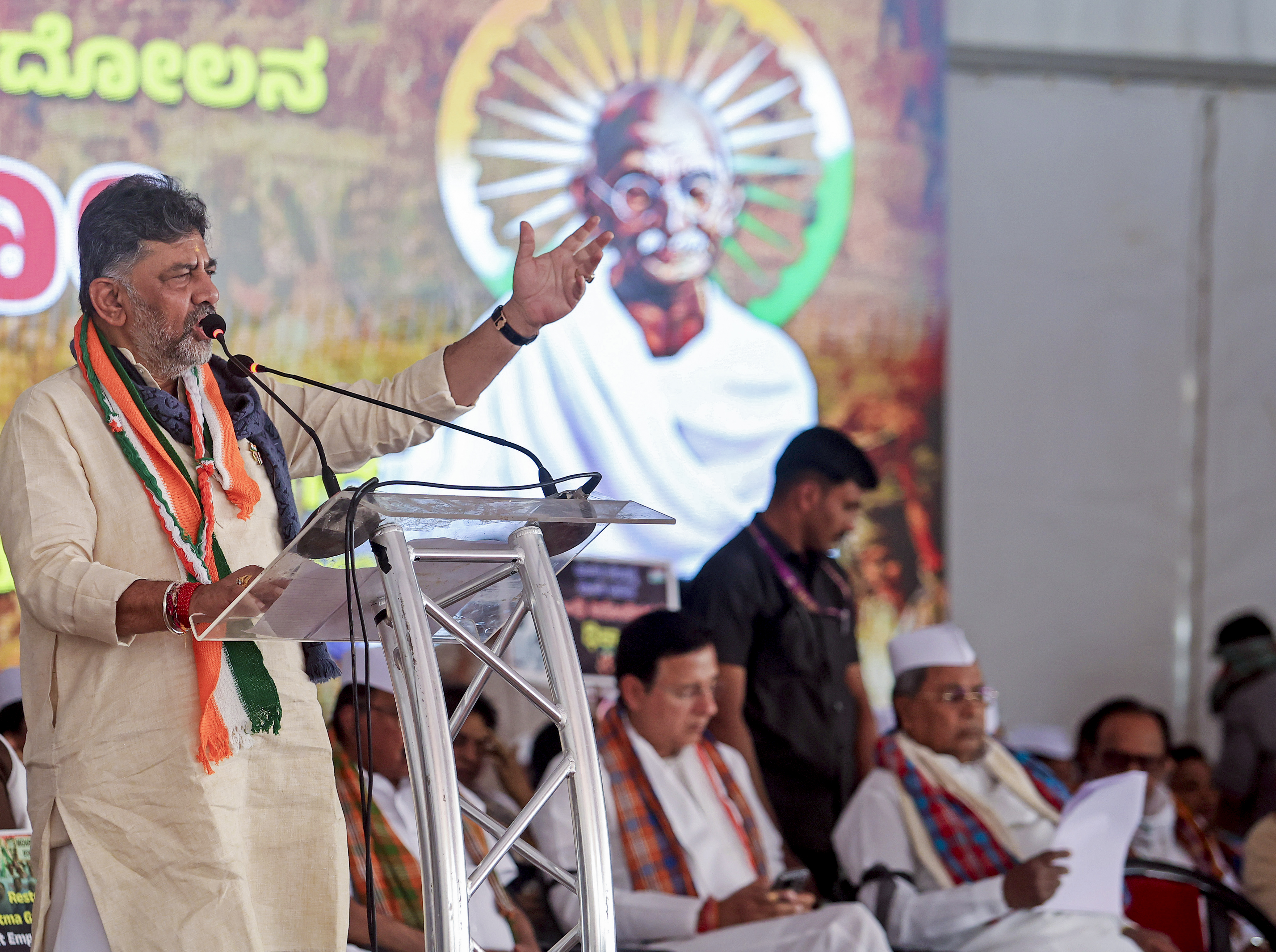
DK Shivakumar said AI does not benefit agriculture and what farmers need is real support (PTI)
Bengaluru, 1 Feb
Karnataka Deputy Chief Minister DK Shivakumar on
Sunday criticised the Centre’s proposal to use Artificial Intelligence (AI) in
the agricultural sector, saying such measures were unlikely to benefit farmers.
Shivakumar’s remarks came after Union Minister Nirmala Sitharaman, in her Budget speech, announced the launch of Bharat-VISTAAR, a
multilingual AI-based platform seeking to integrate AgriStack portals and the
ICAR package on agricultural practices with AI systems.
The Centre’s initiative aims to boost farm
productivity, support better decision-making by farmers and reduce risks
through customised advisory services. Shivakumar claimed that the AI does not
help agriculture.
“They (the Centre) are talking about using AI even in
MGNREGA to decide wages. But they did not pay wages during the agricultural
season. AI does not benefit agriculture. What farmers need is real support,” he
said.
Shivakumar questioned the Centre’s alleged failure to
increase the sugar price. He stressed that
farmers should instead be encouraged to take up silk production.
“Farmers are suffering huge losses. If the sugar price
is not increased then the cooperative sector will be on the verge of closure.
Sugarcane is grown in five districts of the state. Even after eight to nine
years, the sugar price has not been increased,” he charged.
On the proposed high-speed train for Bengaluru,
Shivakumar expressed doubts over its feasibility.
“No high-speed train will come. The 50:50 funding
model will not work. We are ready for a 90:10 model, with the Centre
contributing 90 per cent and the state 10 per cent. They have done this for
other states. They should do the same for Karnataka,” he asserted.
Shivakumar said there were high expectations from the Union Budget for Bengaluru after Prime Minister Modi termed it a “global city”. "There is no benefit for our state from the central budget,” he said.
Anti-farmer,
injustice to K’taka: Farmers criticise budget
Various farmers criticised the Union Budget, terming it “anti-farmer”. They said that apart from the Centre pushing for various high-value crops, there was no major announcement for farmers.
Finance
Minister Nirmala Sitaraman announced proposals to boost coconut, cashew,
sandalwood, agarwood, and walnuts. The State is one of the nation’s largest
producers of coconut and sandalwood and has significant cashew production as
well.
However,
Kurubur Shanthakumar, Karnataka State Sugarcane Growers Association president
and Samyukta Kisan Morcha (SKM) South India convener, noted that SKM and
various farmer organisations had held massive protests demanding a legal
guarantee for Minimum Support Price (MSP).
“But
there is no mention in the Budget,” he told Salar News. Similarly, there was no
mention of insurance cover for crop losses, he added.
He
noted that there was no mentioned of better price for sugarcane despite massive
protests.
The
Centre has “meted injustice to Karnataka,” Badagalapura Nagendra, Karnataka
Rajya Raitha Sangha and Hasiru Sene State Unit President told Salar News.
He
noted that despite southern states paying among the high tax, there was no
major announcement for Southern India.
However,
the Centre “allocated sufficient grants and schemes to its NDA partner states,”
he added.
The
budget had allocated Rs 1,62,671 crore for agriculture and allied activities.
However,
Nagendra noted that there was no major announcement for the improvement of
rural infrastructure.
However,
farmers also noticed some positives from the budget.
“Sops
to fishery sector is a step in the right direction,” Nalini Gowda, President of
Kolar district Farmer Sangha Women Wing told Salar News. The Centre exempted
tax from fisheries in the High Seas and
Exclusive Economic Zone (EEZ). She said that this will help the sea food
market and help young people in the coastal areas.
BJP says budget is pro-farmer; MSME boost to help City
BJP
Leader R Ashoka hailed the Union Budget, saying that agriculture received a
special emphasis “through targeted interventions aimed at enhancing farmers’
income and rural prosperity”.
He
added on X on Sunday that the Mahatma Gandhi Gram Swaraj Scheme to promote
khadi and handloom products and the special packages for coconut, sandalwood
and cashew cultivation, and the ambitious goal of positioning cashew and cocoa
as global export products by 2030 reflects a long-term vision for sustainable
agricultural growth.
Union
Minister of New and Renewable Energy (MNRE) Pralhad Joshi also hailed the Basic
Customs Duty (BCD) exemption on capital goods used in the manufacturing of
lithium-ion cells for batteries and the exemption of BCD on sodium antimonate
used in the manufacture of solar glass, saying it will further strengthen the
domestic solar manufacturing ecosystem.
No tax relief for middle class: Trade activist
The
Union Budget for 2026-27 does not provide tax relief to the middle class that
people had hoped for given the rising inflation through the last year, said
trade activist Sajjan Raj Mehta.
“Generally,
the third budget of a government is expected to bring about some major,
unexpected, and bold reforms,” he said on Sunday. “But the Budget does not meet
that expectation… The public deserved the relief.”
He
noted that there were some positive initiatives in the budget, namely in the
employment and export-oriented sectors.
“Finance
Minister Nirmala Sitharaman has proposed a five-pillar integrated program for
the employment-intensive textile sector, keeping in mind the possibilities of a
European Free Trade Agreement. The aim is to accelerate self-reliance,
modernisation, and job creation,” he said.
He
said that the schemes were a positive sign for handloom, Khadi, MSMEs, and
rural-based textile units.
He
said that the announcement of seven high-speed rail corridors was welcome in
the infrastructure, but the neglect of extremely important business corridors
like Mumbai-Bengaluru was disappointing.
“Overall, this budget is focused on structural reforms and long-term vision, but expectations for immediate relief for the common taxpayer and the business community remain unfulfilled,” he concluded.
Share Now

Leave a Reply
Your email address will not be published. Required fields are marked *
Other Stories

.png)
.png)

.jpg)