India cannot be a superpower without a strong education system: Mansoor Ali Khan
In his first interview after being newly-elected to the Rajya Sabha, Congress leader Mansoor Ali Khan tells Salar News his thoughts on the National Education Policy, the issues he plans to raise in Parliament and vote chori
.png)
-
Mansoor Ali Khan holds a copy of the Constitution outside Vidhana Soudha (Salar)
Naheed
Ataulla
Bengaluru, 21 June
An
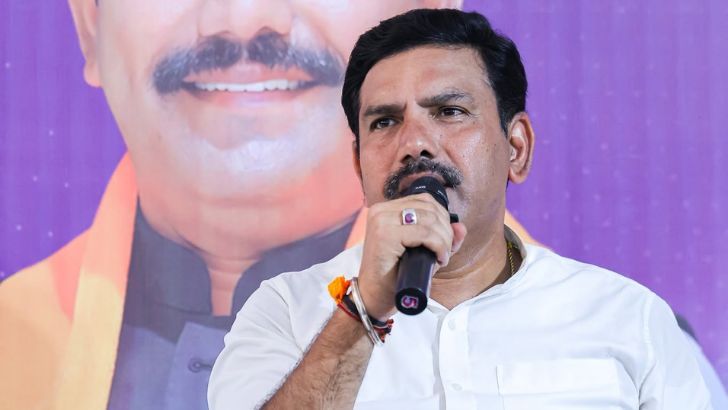
educator and visionary who has shaped countless young minds, Mansoor Ali Khan
now transitions from academia to national politics as the Congress Rajya Sabha
member from Karnataka. He is poised to continue the legacy of his father,
veteran Congressman and former deputy chairman of the Rajya Sabha, K Rahman
Khan.
In his first interview to the media after being elected to the Rajya Sabha, Khan shares his thoughts with Salar News on the National Education Policy (NEP), the issues he plans to raise in Parliament; and vote chori, a matter he has pursued with zeal to expose alleged electoral fraud.
Bengaluru accounts for a staggering portion of the nation's tech economy but is struggling with infrastructure bottlenecks and a water crisis. How will you work to get Central clearance or faster funding for critical state projects like the Mekedatu balancing reservoir project or the Bengaluru Suburban Rail Project?
First, I
would like to thank the Congress leadership and the people of Karnataka for
making me a Rajya Sabha member. Bengaluru is the leading city, the tech capital
of India. It generates a lot of revenue not only for the state of Karnataka but
for the entire country.
As a Rajya
Sabha member, it will be my prime focus to ensure that Bengaluru gets its share
of Central funds and Karnataka gets its due share because, over a period of
time, Bengaluru has been generating wealth and resources for the country. But
somewhere over the last 12 to 13 years, we have not been getting our due share.
There is a
lot of traffic congestion in Bengaluru and urban mobility issues, and we need
support for Bengaluru Metro Rail, suburban rail and airport connectivity.
Bengaluru doesn't just belong to Karnataka; it's the pride of India. Across the
world, India and Bengaluru are spoken of in the same breath.
Even for
projects like Mekedatu, there has to be a federal structure for the fair
sharing of resources. I think these will be among my prime focuses, to get
Karnataka and Bengaluru their fair share of funds.
The Congress-led Karnataka government has been highly critical of NEP and has actively pushed to replace it with a State Education Policy (SEP). As an educator and a lawmaker, what specific structural flaws do you see in the NEP that justify a separate state policy?
Definitely.
When the NEP came in 2020, before that, as an educationist, I don't think we
got enough time to deliberate and debate the policy with stakeholders, be it
the states, private stakeholders, teachers, parents or others.
I feel NEP
has not addressed the education needs of India in totality, whether in higher
education or infrastructure development. Somewhere down the line, I feel NEP is
more about promoting a particular ideology, and that's why there is
apprehension.
When you
make an education policy for a country, it is the duty of the Central
government to ensure that states, private stakeholders, teachers and parents
are taken into confidence.
I am not
opposed to education reforms. Reforms are necessary with time. The last major
education reform was quite some time ago. But the way it has been done, and the
objectives behind it, are the reasons why Karnataka and a few other states have
been highly critical.
How do you plan to take forward the Congress charge of the Election Commission (EC) allegedly facilitating electoral malpractices, with Bengaluru Central Lok Sabha seat being the first case study of vote chori? You have said vote chori does not start on the counting day, but inside the voters' list.
When the
election was held to the Bengaluru Central Lok Sabha seat, the way it was
conducted and the condition of the electoral rolls raised serious concerns.
When
Congress leader Rahul Gandhi came to know about it, he took it up and made the
entire country aware of vote chori.
Noting the
misuse of forms, fake names, fake addresses and nearly 1 lakh anomalies in
Mahadevapura, we approached the EC in all earnestness. We submitted letters and
reminders, but we have not received any response.
In a
democracy, even a doubt about the electoral system should be enough to awaken
the entire system because it concerns your franchise and the integrity of the
EC. The EC cannot be seen as partisan.
Today,
many people feel the EC is biased and unfair. Even that doubt entering the
minds of citizens is unfortunate and dangerous for democracy.
Rahul
Gandhi has made this a movement. After the West Bengal Assembly polls and the
way the Special Intensive Revision (SIR) process has been conducted there,
every Indian should ask: Is our electoral system functioning properly? Is
democracy really as safe as we think? Is the Indian Constitution safe enough?
After the
Bengal elections, the way the Trinamool Congress Party (TMC) has been weakened
and what is happening in Maharashtra with Uddhav Thackeray, the ruling
dispensation is using every possible means to secure a two-thirds majority in
both Houses. This is a very dangerous situation for the country.
What
precautionary measures is the Congress taking with SIR commencing in Karnataka?
We are
conducting awareness programmes. Our booth agents, MLAs, candidates and party
cadre know the entire process.
The SIR
starts from June 30 in Karnataka. Our booth agents, along with booth-level
officers, will go door to door. We will do everything possible to ensure a
sanitized and clean electoral list where no particular caste or community is
targeted.
There are
apprehensions that certain communities may be targeted and opposition parties
fear their voters may be removed. But I think, in Karnataka, the Congress party
is very well prepared.
After West
Bengal's experience, where the process was carried out with very little time,
it appeared to be a deliberate attempt to derail the TMC government.
The
Congress allegation is that after vote chori, this SIR exercise is being used
to defeat the party?
First of
all, if the EC was transparent and communicative, all these doubts and
questions would not arise.
Chief
Election Commissioner Gyanesh Kumar and the Election Commissioners do not
respond. They don't even seem to consider the Opposition an essential part of
democracy.
Earlier
too, the EC existed, but there was a sense of fairness. The entire question
mark around the SIR process is because of the attitude of the EC.
The EC is
particularly harsh on Opposition parties.
Central
examinations like NEET and CBSE have faced criticism regarding paper leaks or
operational inefficiencies. Given your domain knowledge, what policy or
legislative alternatives will you propose in the Rajya Sabha to reform them?
First and foremost, education is the pillar on which India aspires to become a superpower. Any country aspiring to become a superpower should have a very strong education system.
Unfortunately,
NEET exam papers have been leaked time and again. It is unimaginable that the
Education Minister Dharmendra Pradhan continues in office after the NEET
fiasco.
What
decisions are being taken? You talk about changing how papers are transferred,
but you are not addressing what is happening within the system. Who is
responsible? There is no accountability.
Rahul Gandhi's rally in Kota and the issues raised there show that every student sacrifices time, money and effort. Then a paper leak happens and students are asked to reappear for the examination.
This is
not happening for the first time. If you look at CBSE, portals have been
hacked. CBSE has been taking decisions without fully realizing the
implications.
Reforms
are required. An organisation as large as CBSE cannot keep experimenting
without taking stakeholders into confidence. Whether it is NEET or CBSE, I
think this government has lost control and has no clear vision on where it
wants to take the education sector in India.
How do you
plan to position yourself as the rising leader of the Muslim community with the
passing away or fading influence of the community's leaders?
The Muslim
community is a very marginalised community in the country. If you look at
indicators of backwardness and development, the Muslim community is lagging
behind.
As a Rajya
Sabha representative, I would like to focus on this issue.
In a
family with five children, if one child requires extra help, the family
supports that child. Similarly, the Government of India should come forward and
assist with education programmes, socio-economic development, youth
empowerment, employment opportunities and equal opportunities for the
community.
Unfortunately, that is not happening. As far as Karnataka is concerned, we have very capable Muslim leadership. Congress is a party where every Muslim legislator and MP knows that we are committed to the upliftment of the community and that the party is above any individual.
Your father K Rahman Khan was a four-term Rajya Sabha member, served as the House deputy chairman and, as Union minister, was instrumental in bringing amendments to the Waqf Act. What is your takeaway from him?
My father has always been an inspiration to me. He always believed that if the community
is strengthened, the country is strengthened.
The Waqf
issue was very close to his heart. He introduced the Waqf Amendment Bill
because he believed those reforms could address backwardness in education,
healthcare and other sectors.
He always
led by example. Whether as a legislator or MP, he made sure he was effective
both inside and outside the House. He ensured he remained answerable to the
people who put him in that position.
He was an
MP till 2018 and there were other initiatives, such as the Equal Opportunities
Commission, that could not be completed before the UPA-II tenure ended.
Nonetheless,
he remains my inspiration. I would be very happy if I could achieve even 50 per
cent of what he accomplished in his political career.
Your
first Special Mention: Every MP remembers their first major speech in the
House. Which issue pertaining to Karnataka do you plan to raise first?
I will not
say just one or two issues. I have a few issues close to my heart.
One is the
empowerment of youth. Our country is a very young country, and we must empower
our youth. Education is close to my heart and is a very important subject for
me.
I would
definitely like to raise the issue of Karnataka's share of funds from the
Centre. Since ours is a federal structure, the Centre and the states must work
together, and Karnataka should receive its fair share.
Finally, I
would like to take up the cause of the underprivileged and common people.
In my first speech itself, I want to make it clear that if, during my Rajya Sabha term, I am unable to make a difference in the life of a common person, then I would consider that I have not fulfilled my duty as an MP.
Watch full interview on Salar Digital YouTube:
https://youtu.be/RGcLm9umdQg?si=SqDQC0MNvozFEDgz
Share Now

Leave a Reply
Your email address will not be published. Required fields are marked *
Other Stories