Why Tamil writers, activists oppose Jnanpith Award for lyricist Vairamuthu
Leading the charge is Jeyamohan, an influential figure in contemporary Indian literature, who called Vairamuthu a "ridiculous film lyricist".
PTI
-
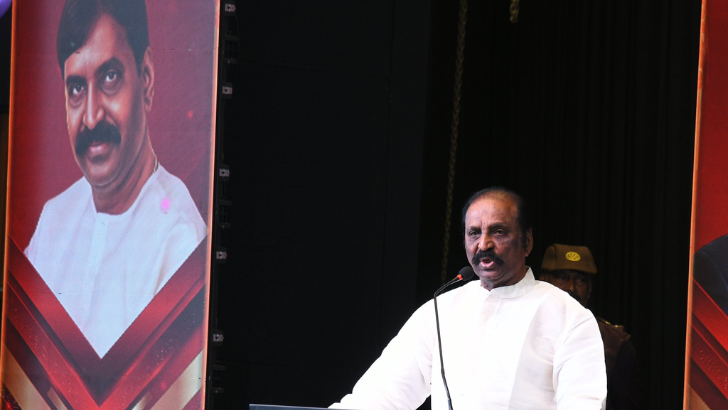
17 women accused Vairamuthu of sexual harassment during the 2018 #MeToo movement in India (X@vairamuthu)
Chennai, 16 Mar
The recent decision to confer the prestigious literary
honour, Jnanpith Award, upon lyricist Vairamuthu has triggered a significant
wave of condemnation from the top echelons of the Tamil intelligentsia,
signalling an evolving cultural resistance against the veteran lyricist.
Leading the charge is Jeyamohan, one of the most influential
figures in contemporary Indian literature, who called him a "ridiculous
film lyricist".
In a formal communication to the Jnanpith Committee,
Jeyamohan expressed deep disdain for the recognition and pointedly dismissed
the lyricist’s literary credentials, asserting that the survival of a culture
depends on its moral clarity and that technical proficiency in film songs does
not equate to a contribution to the serious literary canon.
In his letter to the committee, Jeyamohan was unequivocal in
his assessment of the awardee's standing in the creative world.
He stated: "Mr Vairamuthu is neither a poet nor a
writer; he is merely a ridiculous Tamil film lyricist. He plays no part at all
in contemporary Tamil literature. I hereby express my deep disdain."
This sharp critique serves to decouple Vairamuthu’s
commercial success in the film industry from the high-art standards expected of
a literary icon.
The backlash is also rooted in the 2018 #MeToo movement in
India, during which seventeen women, including high-profile singer Chinmayi
Sripaada, accused Vairamuthu of "sexual harassment and misconduct".
Jeyamohan emphasised that honouring individuals who face credible
accusations of misconduct, while lacking genuine literary merit, undermines the
very community that such awards claim to celebrate, effectively terming the
recognition a "stain" on the collective dignity of Tamil letters.
This sentiment was echoed across various literary platforms,
indicating a rare consensus among otherwise disparate intellectual circles.
Akazh magazine, a prominent voice for contemporary Tamil discourse, published a
scathing editorial questioning the institutional mechanisms that allow such
honours to bypass ethical scrutiny.
The magazine asserted that the silence of award committees
in the face of public outcry reflects a deep-seated systemic apathy toward the
safety and dignity of women in the creative arts. By providing a platform for
this dissent, the publication underscored that the issue is no longer a private
dispute but a public concern regarding the values that the Tamil literary world
chooses to project to the global stage.
Postmodernist writer Charu Nivedita also joined the fray,
offering a characteristically blunt assessment of the controversy. Known for
his transgressive and often provocative views, Nivedita’s condemnation added a
different dimension to the critique, focusing on the power structures within
the Tamil film and literary industries.
He suggested that the continued patronage of the lyricist by
political and cultural elites is a symptom of a broader malaise that
prioritises proximity to power over ethical consistency.
"In our society, there is a strange logic that even if
a man is accused of sexual harassment by 17 women, he can still be hailed as a
Kavignar or great poet as long as he has political clout. This is not an award
for literature; it's a victory march for predator," wrote Nivedita, in his
website.
Nivedita’s intervention is seen as particularly significant
because it bridges the gap between high literature and pop culture.
In a series of social media posts reacting to the current
honours, playback singer Chinmayi Sripaada questioned how a man named by
multiple women across different age groups as a molester could continue to be
celebrated by the state and literary bodies.
She also criticised the silence and support of industry
veterans, including Kamal Haasan and Pawan Kalyan, stating that the elevation
of such individuals serves to silence victims and reinforces a culture of
impunity.
It is to be noted that #MeToo allegations and intense public
pressure previously led to Vairamuthu declining the ONV Literary Prize in 2021.
Share Now

Leave a Reply
Your email address will not be published. Required fields are marked *
Other Stories

.jpg)
.png)
.png)