




'Delay not trump card': SC denies bail to Umar Khalid & Sharjeel Imam, grants to 5 others
Activists Gulfisha Fatima, Meeran Haider, Shifa Ur Rehman, Mohd. Saleem Khan and Shadab Ahmad have been given bail.
PTI
-
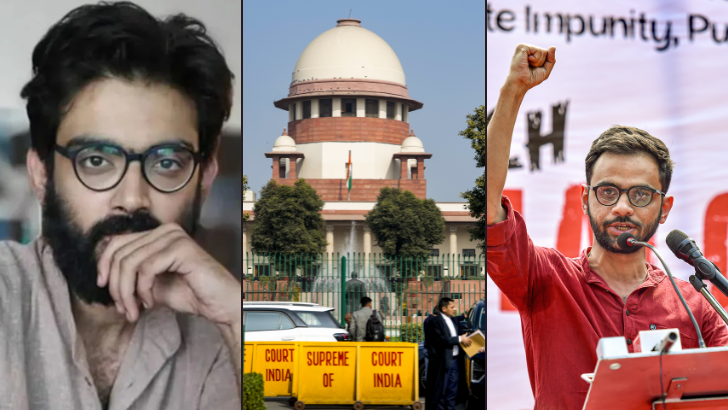
The violence erupted during protests against the CAA and NRC (PTI/Facebook)
New Delhi, 5 Jan
The Supreme Court on Monday refused bail to activists Umar
Khalid and Sharjeel Imam in the 2020 Delhi riots conspiracy case but granted it
to five others, citing "hierarchy of participation" and saying all
accused in the case do not stand on the same footing.
There was a prima facie case against Khalid and Imam under
the Unlawful Activities (Prevention) Act, a bench of Justices Aravind Kumar and
N V Anjaria said. While the two will remain in jail, activists Gulfisha Fatima,
Meeran Haider, Shifa Ur Rehman, Mohd. Saleem Khan and Shadab Ahmad have been
given bail.
Khalid and Imam can file fresh bail applications after the
examination of protected witnesses or after one year from today, the court
said. The two stand on qualitatively different footing as compared to other
accused, it said.
The prosecution prima facie disclosed "a central and
formative role" and "involvement in the level of planning,
mobilisation and strategic direction extending beyond episodic and localised
acts", the bench said.
The February 2020 riots in northeast Delhi left 53 peopledead and more than 700 injured.
According to the court, delay in trial does not operate as a
"trump card" which automatically displaces statutory safeguards.
"All the appellants do not stand on equal footing as
regards culpability. The hierarchy of participation emerging from the
prosecutions case requires the court to examine each application
individually," the bench said, adding that the roles attributed to them
are different.
"This court is satisfied that the prosecution material
disclosed a prima facie allegation against the appellants Umar Khalid and
Sharjeel Imam... This stage of proceedings does not justify their enlargement
on bail," the apex court said.
Directing the trial court to expedite the process of bail,
the bench imposed 12 conditions and said the misuse of liberty would attract
the cancellation of the bail.
"Right to liberty under Article 21 of the Constitution
requires the State to justify prolonged pre-trial custody," the bench
said.
The top court said that while bail in UAPA cases is not
given as a matter of routine, the law does not mandate denial of bail as
default. It also does not exclude the court's jurisdiction to allow bail.
Imam was arrested on 28 January 2020 for speeches made
during anti-CAA protests. He was later arrested in a larger conspiracy case in
August 2020. Khalid was arrested on 13 September, 2020.
On 10 December, the top court reserved its verdict on
separate pleas of the accused after hearing arguments from Solicitor General
Tushar Mehta and Additional Solicitor General S V Raju, appearing for Delhi
Police, and senior advocates Kapil Sibal, Abhishek Singhvi, Siddhartha Dave,
Salman Khurshid and Sidharth Luthra, appearing for the accused.
Strongly opposing the bail pleas, Delhi Police said the riots
were not spontaneous but an orchestrated, pre-planned and well-designed attack
on India's sovereignty.
Raju contended that all the participants are liable for each
other's acts in a conspiracy. Acts of one conspirator can be attributed to
others. Imam's speeches can be attributed to Umar Khalid. And Imam's case will
be considered as evidence against the others, he told the bench, which
conducted hearings on the bail pleas on multiple days.
The additional solicitor general argued that Khalid
deliberately planned to leave Delhi before the riots as he wanted to deflect
responsibility.
Seeking bail, Imam expressed anguish before the apex court
for being labelled a "dangerous intellectual terrorist" without a
full-fledged trial or a single conviction.
Senior advocate Siddharth Dave, appearing for Imam,
contended that he was arrested on January 28, 2020, which was before the
communal violence rocked northeast Delhi, for his speeches that alone cannot
constitute the offence of criminal conspiracy in the riots case.
All seven accused were booked under the stringent
anti-terror UAPA and provisions of the Indian Penal Code (IPC) for allegedly
being the "masterminds" of the riots.
According to Section 16 of the UAPA, "Whoever commits a
terrorist act shall, if such act has resulted in the death of any person, be
punishable with death or imprisonment for life, and shall also be liable to
fine."
The violence erupted during widespread protests against the
Citizenship (Amendment) Act (CAA) and the National Register of Citizens (NRC).
The accused moved the apex court, challenging the Delhi High
Court's 2 September order denying them bail in the larger conspiracy case of
the February 2020 riots.
Share Now

Leave a Reply
Your email address will not be published. Required fields are marked *
Other Stories


.png)
.png)
.png)
