The warmth of radio waves in a cold digital age
India’s broadcasting journey began in June 1923 with the Radio Club of Bombay's first transmission.
Salar News
-
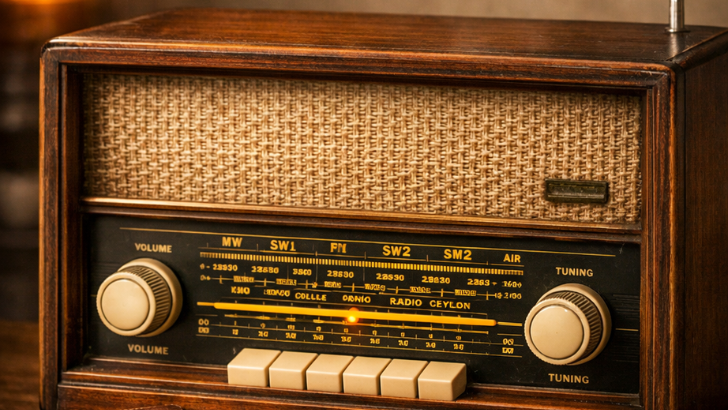
World Radio Day is celebrated on 13 February every year (AI)
By Utthara Kumari B
Who even listens to radio these days? Well, many still do. Listener habits may have changed but not the love for this old friend.
World Radio Day is celebrated on 13 February every year to
spread awareness about radio as a medium to inform, educate, and entertain.
Despite the theme this year being ‘Radio and Artificial Intelligence’,
nostalgia is in the AIR!
This brown box occupied a pride of place in our house,
sitting on a pedestal in the hall. It was our radio, our dignified and
comforting companion.
There used to be a well-thumbed book with a brown cover. It
was the radio licence which had to be renewed every year.
I grew up on a staple diet of radio in the 1970s-1980s. It
gave us news, it gave us ‘man chahe geet’, ‘chutkule’, and cricket commentary.
Television came later. And Internet even more later.
We would wake up to the opening strains of the AIR signature
tune.
A window to the world, radio served as the soundtrack of our
lives.
Two broadcasting stations dominated the airwaves - All India
Radio (AIR) and Radio Ceylon when the country came to a standstill every
Wednesday night at 8pm to listen to Binaca Geetmala.
India’s broadcasting journey began in June 1923 with the
Radio Club of Bombay's first transmission. The Indian Broadcasting Company
(IBC) was established on 23 July, 1927, marking the birth of organised radio
broadcasting in the country.
All India Radio (AIR) came into existence in 1936. In 1956,
AIR was officially renamed ‘Akashvani’.
Vividh Bharati, the entertainment wing of AIR where
advertisements were allowed, started in 1957.
My day would begin by listening to the devotional songs on
Vividh Bharati (medium wave) and would end with a programme called ‘Bela Ke
Phool’ at night.
At 7.30am sharp, a musical voice would say ‘Sangeeet
Saritaaaaa’, a programme where a Hindustani raag and a film song based on that
raag would be broadcast every day.
In between there were many programmes like ‘Manoranjan’,
‘Fauji bhayiyon ki Jaimala’, ‘Hawa Mahal’ etc.
There would be the exciting anticipation on whether my
favourite song would be played. But these days when we can listen to any song
any time at the click of a button, we no longer have such delicious
uncertainties.
Our time was measured not by a clock but by the programmes
on the radio. Like the pips before the 9pm news in English on AIR. It meant it
was time to go to bed.
The arrival of the transistor, with an antenna sticking out,
freed us from the anchored nature of the radio. You could hug it, cradle it,
take it anywhere.
The short wave used to be quite moody. Just at the moment I
would be all ready for my favourite song, the ‘little sistor’ would crackle,
hiss, produce more static... increasing my frustration. I would bang it, shake
it, take it round the house looking for that ideal spot where it would catch
the signals.
And sometimes our routine would be interrupted by the
cricket commentary on AIR whenever India played the Test matches.
You would see everyone glued to a transistor at shops, at
homes, at offices, at street corners... and suddenly hear a collective scream
denoting that a player had hit a six or got out.
Radio made me not only learn about many things, it also made
me discover a place called Jhumri Telaiya, which I always thought was a
fictional place. This town in Jharkhand became legendary for dominating song
requests on radio.
And radio expanded gradually. Private participation wasn't
allowed until 1993 when the government experimented with a daily, two-hour private
show slot on the FM channels in Delhi and Mumbai. In 2001 the first phase of
private sector participation (FM Phase I) India's radio sector began.
Over the years, the way people consume media has
fundamentally changed. Today, a growing range of FM channels, streaming and
podcast apps and AI compete for our divided attention though they give us
unprecedented control over what we listen to, when, and how.
But AI is a tool, and not a voice.
Can the conventional radio withstand the digital onslaught though it is reinventing itself
while keeping its core intact?
It can. Because radio is an emotion.
The writer is a veteran journalist.
Share Now

Leave a Reply
Your email address will not be published. Required fields are marked *
Other Stories


.png)
.png)
.png)