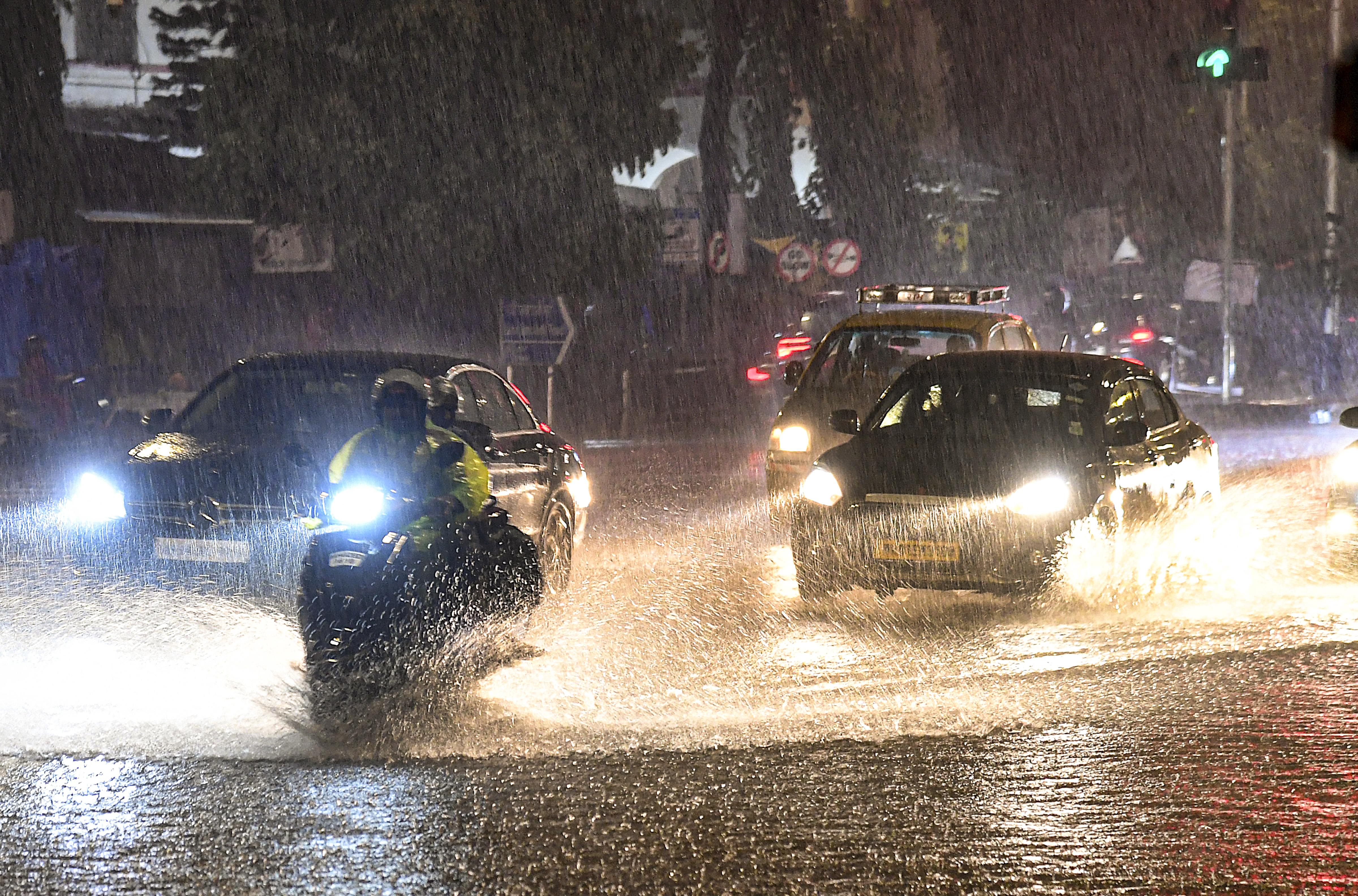
Heavy rain floods parts of Mumbai, disrupts train services
Several parts of Mumbai received over 200 mm of rain in the 24 hours ending at 8am, officials said.
PTI
-
Commuters faced delays & overcrowding at several stations as train services were regulated following the incident (PTI)
Mumbai, 24 June
A day after the monsoon’s onset in Mumbai, heavy overnight rains on Wednesday disrupted suburban train services, caused waterlogging in low‑lying areas, and left commuters stranded.
Parts of
the metropolis recorded more than 200 mm of rainfall in the 24 hours ending at
8 am, officials said.
The India
Meteorological Department (IMD) has forecast moderate to heavy showers
accompanied by thunder and lightning in Mumbai and its suburbs over the next 24
hours.
Ruling
Shiv Sena MLC Manisha Kayande urged Mumbai Mayor Ritu Tawde to intensify
efforts for thorough cleaning of drains and removal of dry waste, stressing
that such measures are vital to prevent waterlogging and traffic disruptions
during the monsoon.
Kayande,
whose party is a constituent of the BJP-led Mahayuti government, also said the
issue should not be viewed through a political lens and stressed that the focus
must remain on resolving problems faced by people.
"It
is not about politics but solving people's problems," she told reporters
in the Vidhan Bhavan premises.
The
Brihanmumbai Municipal Corporation is controlled by the BJP and Shiv Sena.
The island
city recorded an average rainfall of 195 mm, while the western suburbs received
208 mm and the eastern suburbs 167 mm during the 24 hours ending at 8am,
according to civic data.
The
southwest monsoon reached Mumbai on Tuesday, 13 days after its normal onset
date, bringing widespread rainfall across the city and suburbs and much-needed
relief from the sweltering heat.
The
overnight rain, however, inundated several low-lying areas of the city by
Wednesday morning, affecting road traffic and the daily commute of thousands of
residents.
Civic
officials said water accumulation was reported at the Andheri subway, Hindmata
and King's Circle areas during the early morning hours, affecting vehicular
movement and leading to traffic congestion on key roads.
Suburban
railway services were also affected as rainwater accumulated on tracks at some
locations, though officials said the water level remained below the danger mark
prescribed for suspending train operations.
Several
commuters complained of delayed services and overcrowded local trains during
the morning peak hours, particularly on Central Railway corridors.
The heavy
rain also affected Central Railway's Trans-Harbour line services between Thane
and Vashi/Panvel in neighbouring Navi Mumbai after a track cave-in caused by
excessive water flow between Turbhe and Koparkhairane stations, officials said.
A Central
Railway spokesperson said the up line on the Thane-Vashi section was declared
unsafe at 5.06am, while the down line was declared unsafe at 5.50am,
affecting train operations during the morning rush hour.
The up
line was restored at 7.27am with a speed restriction of 10 kmph, while the
down line was declared safe at 7.35am with trains permitted to run at 30 kmph.
"Track
cave-in occurred because of excess water flow," the official said.
Commuters
faced delays and overcrowding at several stations as train services were
regulated following the incident.
Western
Railway services, however, were operating normally despite the heavy rainfall,
officials said.
A high
tide of 3.41 metres was recorded at 8.28 am, while another high tide of 3.35
metres is expected at 7.41 pm, the Brihanmumbai Municipal Corporation (BMC)
said.
Generally,
heavy downpours combined with high tide lead to waterlogging in the metropolis,
which is surrounded by the Arabian Sea.
Sena MLC
Manisha Kayande said cleaning of "nullahs" (drains) was essential in
Mumbai, though some amount of waterlogging was expected during periods of heavy
rainfall.
Some
drains had not been cleaned adequately, which contributed to water accumulation
in parts of the city, Kayande said.
"The
mayor may need to work harder to clean the nullahs and remove dry waste from
them so that water does not get logged and affect overall vehicular
movement," she added.
Officials
said civic and disaster management teams were on alert and monitoring
rain-related incidents across the metropolis as rainfall activity is expected
to continue.
Earlier,
the IMD issued a red alert for Mumbai and Palghar at 4am on Wednesday, valid
for three hours, warning of thunderstorms, lightning, intense to very intense
rainfall, and winds of 40-60 kmph. It was downgraded to an orange alert at 7am
for the next three hours, with moderate to intense spells of rain forecast for
Mumbai, Thane, Raigad, Palghar and Sindhudurg districts.
The
southwest monsoon finally hit Mumbai on Tuesday. The normal onset date of the
monsoon in Mumbai is 10 June. Notably, in 2023, the monsoon arrived even later,
on 25 June, according to IMD data.
The
longest delay was in 1974 and 1958 when the onset of monsoon was recorded on 28 June, according to IMD.
Share Now

Leave a Reply
Your email address will not be published. Required fields are marked *
Other Stories
.png)

.jpg)