




'Rarest of rare': Pune court awards death penalty in 3-year-old’s rape-murder
Terming the case “rarest of the rare,” the court rejected defence’s plea for leniency based on Bhimrao Kamble's age.
PTI
-
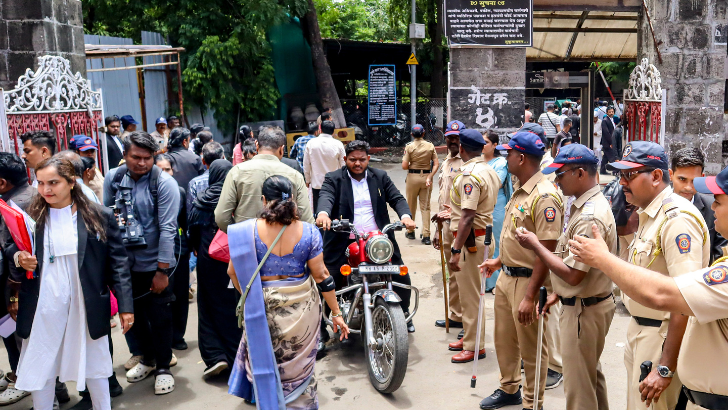
Kamble was accused of luring the girl with the promise of snacks and seeing a newborn calf (PTI)
Pune/Mumbai, 29 June
A special Pune court on Monday sentenced a 65-year-old man
to death for the kidnapping, rape, and murder of a three-year-old girl in
Nasrapur village, a verdict coming within 60 days of the horrific crime that
sparked widespread outrage and protests across Maharashtra.
Terming the case “rarest of the rare,” Additional Judge SR
Salunkhe rejected the defence’s plea for leniency based on age of the accused,
Bhimrao Kamble, highlighting his history of violence and stated his depravity
shocked the conscience of the judiciary and society.
"The offence was committed outrageously and involved
inhuman treatment and torture of the victim. The victim was an innocent,helpless child. The murder was committed to satisfy lust, which evidences total
depravity. It was a cold-blooded murder without provocation. The crime was
committed so brutally that it shocks not only the judicial conscience but even
the conscience of society," Judge Salunkhe observed.
As the judge pronounced the capital punishment, the victim's
family broke down in court. The court had convicted the accused on June 25,
within sixty days of the crime, which took place on 1 May.
Kamble was accused of luring the minor girl with the promise
of snacks and showing her a newborn calf in Nasrapur village under Bhor taluka
of Pune district in western Maharashtra. He took her to a shed near a cattle
barn, subjected her to sexual and unnatural assault, and subsequently murdered
her by gagging her and inflicting chest injuries.
Three of the offences he was charged under carry the
prescribed punishment of capital punishment. The prosecution had sought the
death penalty in the case, arguing that Kamble was "beyond reform"
and had prior offences involving a 62-year-old woman, a 17-year-old girl, and
an animal.
The defence cited his age and denial of the crime as
mitigating factors. The court, however, held that Kamble's age was an
aggravating factor rather than a mitigating one.
"The thirst for lust of the accused is not extinguished
even at such an age. Rather, it has reached a very dangerous stage. The
injuries noted on the body of the victim reflect the inhuman behaviour of the
accused with a child of just three years," the judge stated. He further
observed that whatever the accused wanted to do with the child, he did
"fearlessly, most violently and without bothering about consequences,
because he had prior experience that even if prosecuted, nothing would happen
in court".
Judge Salunkhe noted that despite stringent punishments and
special courts enacted after the Nirbhaya case to ensure speedy trials in
crimes against children, "such incidents continue and the collective
conscience of society remains shocked".
Talking to reporters outside the court, special public
prosecutor Ajay Misar termed the ruling "landmark," stating that the
prosecution successfully relied on 12 Supreme Court precedents to establish the
"rarest of the rare" criteria.
"The accused committed the offence in a cold-blooded
and calculated manner. The prosecution argued that the accused does not deserve
any mercy. This was an exceptionally heinous crime. The victim was sexually
assaulted even after her death," he said.
During the trial, the court recorded the statements of 10
witnesses, including children, in a single day, he said. The prosecution proved
all charges, including kidnapping, molestation, rape and murder, along with
offences under the Protection of Children from Sexual Offences (POCSO) Act.
The father of the three-year-old victim expressed
satisfaction over the court's verdict and said the family now wants the
execution of the order. Talking to reporters, he said, "We are satisfied
with the decision given by the honourable court. We already demanded strict
action against the accused. The demand will be fulfilled once the order of the
death penalty is executed."
Chief Minister Devendra Fadnavis hailed the verdict as a
"new benchmark" in speedy justice, saying the convict was handed
triple death sentence within 60 days of the crime.
He said while the investigation and filing of the
chargesheet are the responsibility of the police, the subsequent timeline is
largely in the hands of the judiciary.
Fadnavis praised Pune Rural Superintendent of Police (SP)
Sandeep Singh Gill, the investigating team and all officials involved in
handling the sensitive case.
Share Now

Leave a Reply
Your email address will not be published. Required fields are marked *
Other Stories
.jpg)

.jpg)



.jpg)
