




Trump increases global tariffs to 15% amid Supreme Court fallout
Trump had imposed sweeping “reciprocal tariffs” last year under an emergency powers act, but the court ruled this law did not authorize him to do so
PTI
-
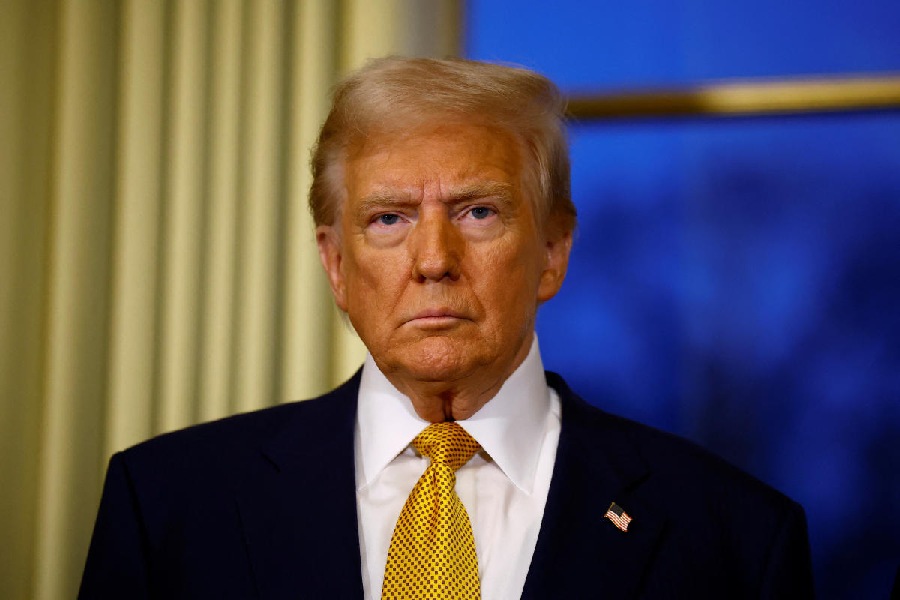
Donald Trump admonished the justices of the SC and called the democratic justices who ruled against the tariffs a “disgrace to the nation”(PTI)
Brisbane, 22 Feb
US President Donald Trump has announced the United States will increase baseline tariffs on imports from all countries to 15 per cent, as the fallout continues from a seismic Supreme Court ruling on Friday.
Trump
had imposed sweeping “reciprocal tariffs” last year under an emergency powers
act, but the court ruled this law did not authorise him to do so.
Speaking
in the wake of the ruling on Friday, Trump admonished the justices of the Supreme Court. He called the Democratic justices who ruled against the tariffs
a “disgrace to the nation”.
He also
said he felt “ashamed” of members of the court he considered conservative who
had voted against his use of emergency powers.
Trump’s
statement was riddled with insults and inaccuracies. However, he admitted he
had tried to “make things simple” by using the Emergency Powers Act. He went on
to say he does have other options, but those options would take more time. This
was one part of his speech that was indeed accurate.
With the
clock already ticking on his landmark trade agenda, and the multi-billion
dollar question of refunds looming, what might Trump do next? Here’s what could
now be in store for both Australia and the world.
The new 15 per cent rate is an increase on the 10 per cent global baseline tariff enacted shortly after the ruling, using a different law, and will hit some Australian exports.
This
part of the law has never been used. However, it appears to clearly allow the
president to impose tariffs of up to 15 per cent, and for a period of no more
than 150 days.
But
Trump said during this five-month period, his administration would investigate
the use of yet another law, section 301 of the Trade Act of 1974.
This
section does allow the president to impose tariffs in response to foreign
countries that violate US rights under international trade agreements, or that
burden or restrict US commerce in “unjustifiable”, “unreasonable” or
“discriminatory” ways. However, it requires some steps to be followed.
The
process for using this law is detailed and cannot be subverted. It would likely
take either years or vast amounts of resources to introduce tariffs that were
anywhere near the “Liberation Day” tariffs.
If nothing
else, it requires consultations with the countries upon whose goods those
tariffs will be imposed.
Section
301 has previously been used to impose tariffs on China, following an
investigation by the United States Trade Representative in 2018.
Another avenue for the president to bypass Congress is a specific section of a different law, Section 232 of the Trade Expansion Act of 1962, that applies to a particular sector of the economy.
This is
the power used to impose tariffs on steel and aluminium in the first Trump
administration in 2018.
However,
it can’t be used to recreate sweeping tariffs on all imports. This
provision is generally product-specific and requires an investigation into the
national security threat.
Its use
to impose steel and aluminium tariffs has been challenged by multiple trading
partners at the World Trade Organisation. A panel of experts ruled the US had
used a special national security exception erroneously.
However,
despite this violation, Trump has suggested that he isn’t bound by
international law.
The Supreme Court’s ruling on Friday means all tariffs introduced under the International Emergency Economic Powers Act (IEEPA) were unlawfully collected.
If all
collected duties are refunded, it’s estimated that the total repayment could reach
approximately USD 175 billion (AUD 247 billion).
Much to
the president’s frustration, there was no clarity within the Supreme Court’s
ruling on the process for refunds of illegally collected tariffs.
That
silence, which prompted Trump to refer to the decision as “terrible” and
“defective”, was likely because this would be handled by other courts.
Back in
December, the US Court of International Trade stated it would have the
authority to order reliquidation and refunds of the sweeping tariffs if the
Supreme Court ultimately ruled them unlawful.
Many large
companies had already anticipated this ruling and acted to get on the front
foot. For example, in late November, large retailer Costco sued the Trump
administration to secure a full refund of tariffs in the event the Supreme
Court deemed them unlawful.
In late December, faced with an avalanche of similar cases, the Court of International Trade temporarily halted all cases where companies were claiming relief from IEEPA tariffs ahead of the Supreme Court’s ruling.
Some
importers have argued that because the tariff payments were itemised, receiving
refunds should not be messy.
But the
process for refunds may not be as straightforward as it should be. Trump
suggested they could be “in court for the next five years”.
What
does this all mean for Australia?
Australia’s previous 10 per cent rate was much lower than many other nations, but now, at 15 per cent, the playing field has been levelled – at least for the next 150 days.
Australian
exporters don’t pay these tariffs directly themselves, but may be pressured to
absorb some of the cost, which makes their imports less competitive in the US
market.
However,
not all Australian exporters are in the same position. The proclamation issued
by the White House listed some exceptions, including beef, critical minerals,
energy products and pharmaceuticals.
At Friday’s press conference, Trump said “great certainty” had been brought back to the United States and the world. In truth, the uncertainty is far from over.
Share Now

Leave a Reply
Your email address will not be published. Required fields are marked *
Other Stories





.png)
