STT hike on Futures dampen stock market sentiment; Sensex, Nifty crash nearly 2 pc
Stock exchanges held a special Budget Day trading session for Sitharaman’s Budget presentation.
PTI
-
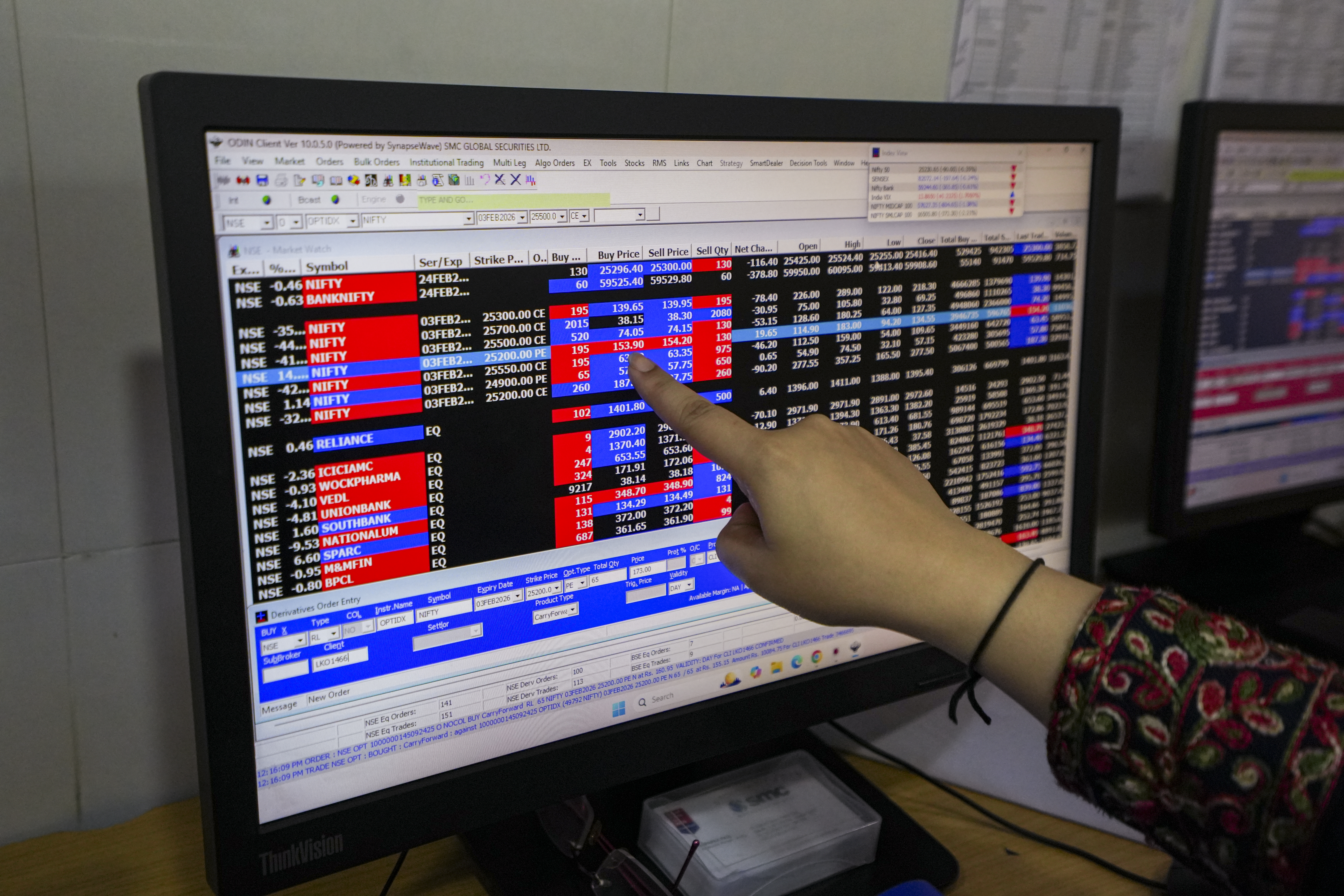
Sensex and Nifty fell after the Budget raised STT on commodity futures to 0.05% (PTI)
Mumbai, 1 Feb
Benchmark stock indices Sensex and Nifty dived sharply by nearly 2 per cent on Sunday, logging their worst decline in six years on a Budget day, after Finance Minister Nirmala Sitharaman proposed a hike in the Securities Transaction Tax (STT) on derivatives.
Reversing
the early gains, the 30-share BSE Sensex plunged sharply by 2,370.36 points or
2.88 per cent to slide below the 80,000-mark at 79,899.42 in afternoon trade as
the finance minister announced a hike in STT on futures contracts to 0.05 per
cent from the current 0.02 per cent.
The
barometer settled at 80,722.94, down 1,546.84 points or 1.88 per cent.
The
50-share NSE Nifty tanked 495.20 points or 1.96 per cent to settle at
24,825.45. During the day, it tumbled 748.9 points or 2.95 per cent to
24,571.75.
Stock
exchanges held a special Budget Day trading session on Sunday in view of the budget presentation by Sitharaman for the next financial year.
Sensex
and Nifty logged their worst decline in six years on a Budget day. Earlier on 1February 2020, the 30-share BSE benchmark had ended 2.42 per cent lower, and
the Nifty tanked 2.51 per cent.
Investors'
wealth eroded sharply by Rs 9.40 lakh crore on Sunday, tracking a sharp decline
in equities. Market capitalisation of BSE-listed companies eroded by Rs
9,40,581.75 crore to Rs 4,50,61,658.60 crore (USD 4.90 trillion) in a single
day.
"Market
unease, however, is centred on the increase in STT on F&O, particularly the
sharper hike on futures. This comes on the back of higher capital gains taxes
last year, raising overall transaction costs for market participants,"
Pranav Haridasan, MD and CEO, Axis Securities, said.
Futures
are a margined, risk-managed product and not typically the primary source of
retail excess, which raises questions on whether higher STT will deliver the
desired outcome or instead weigh on liquidity, participation and India’s market
cost competitiveness, he noted.
"These
concerns are being voiced by foreign investors and domestic traders, and are
reflected in the immediate market reaction," Haridasan added.
From the
30 Sensex firms, State Bank of India tanked 5.61 per cent, while Adani Ports
lost 5.53 per cent.
Bharat
Electronics, ITC, Tata Steel, UltraTech Cement and Reliance Industries were
also among the laggards.
Tata
Consultancy Services, Infosys, Sun Pharma and Titan were the gainers.
Among
indices, BSE PSU Bank dived the most by 5.60 per cent, metal tanked 3.85 per
cent, commodities (3.35 per cent), energy (3.14 per cent), capital goods (3.02
per cent), utilities (2.98 per cent), industrials (2.66 per cent) and power
(2.52 per cent).
IT and
BSE Focused IT were the winners.
A total
of 2,375 stocks declined, while 1,759 advanced and 175 remained unchanged on the
BSE.
"The
increase in Securities Transaction Tax (STT), especially in futures and
options, is likely to act as a marginal negative for foreign portfolio investor
(FPI) flows in the near term, particularly for high-frequency and
derivative-focused global funds," Aakash Shah, Technical Research Analyst
at Choice Equity Broking, said.
Foreign
institutional investors bought equities worth Rs 2,251.37 crore on Friday,
according to exchange data.
"The
proposed increased STT in F&O is a dampener for capital market entities in
the short term, but may augur well in the long term," HDFC Securities'
managing director and chief executive Dhiraj Relli said.
Vinod
Nair, Head of Research, Geojt Investments Limited, said, The budget supports
sectors affected by global trade tariffs and focuses on emerging areas of
development, including data centres, GCC, semiconductors, biopharma, rare earth
elements, and manufacturing.
Additionally,
it extends support to traditional sectors like textiles, aquaculture, and
MSMEs, which have been impacted by global protectionist trade policies, he
said.
"Despite
these measures, the market's reaction has been negative, primarily due to low
expectations, limited outlays and the negative bias created by the increased
Securities Transaction Tax (STT) for futures, triggering a knee-jerk
response," Nair noted.
Asian
and European markets are closed on Sunday due to holidays. US markets ended
lower on Friday.
"The
Finance Minister’s proposal to raise STT on futures to 0.05% is structurally
negative for the capital market ecosystem, particularly F&O-driven businesses.
Higher transaction costs are likely to reduce trading volumes, dampen
short-term momentum, and lower profitability for active market participants.
FII participation in derivatives may also moderate as post-tax trading
efficiency declines, impacting overall liquidity.
"This
can create a cascading effect on revenue streams of broking companies,
exchanges, AMCs, and depositories, which are closely linked to market turnover.
With derivatives volumes already shrinking in recent months, the hike may
further pressure near-term earnings visibility. While fiscally supportive, the
measure poses headwinds for capital-market-linked stocks," Raj Gaikar,
Research Analyst, SAMCO Securities, said.
"Indian
equity markets witnessed sharp, event-driven volatility during the special
Budget Day session, with benchmark indices slipping into a risk-off mode as
investors digested the Union Budget 2026-27.
"Initial
optimism faded quickly as higher transaction costs driven by the increase in
Securities Transaction Tax (STT) on equity derivatives, and the lack of strong
measures to revive foreign capital inflows, weighed on sentiment and near-term
liquidity expectations," Ponmudi R, CEO of Enrich Money, an online trading
and wealth tech firm, said.
On
Friday, the Sensex declined 296.59 points, or 0.36 per cent, to settle at
82,269.78. The Nifty dropped 98.25 points, or 0.39 per cent, to end at
25,320.65.
Share Now

Leave a Reply
Your email address will not be published. Required fields are marked *
Other Stories

.png)
.png)
.png)