India slams Pakistan for 'unwarranted' remarks on J&K at UNSC meeting
India-Pakistan ties remain strained over Kashmir, with New Delhi rejecting third-party mediation on the issue.
PTI
-
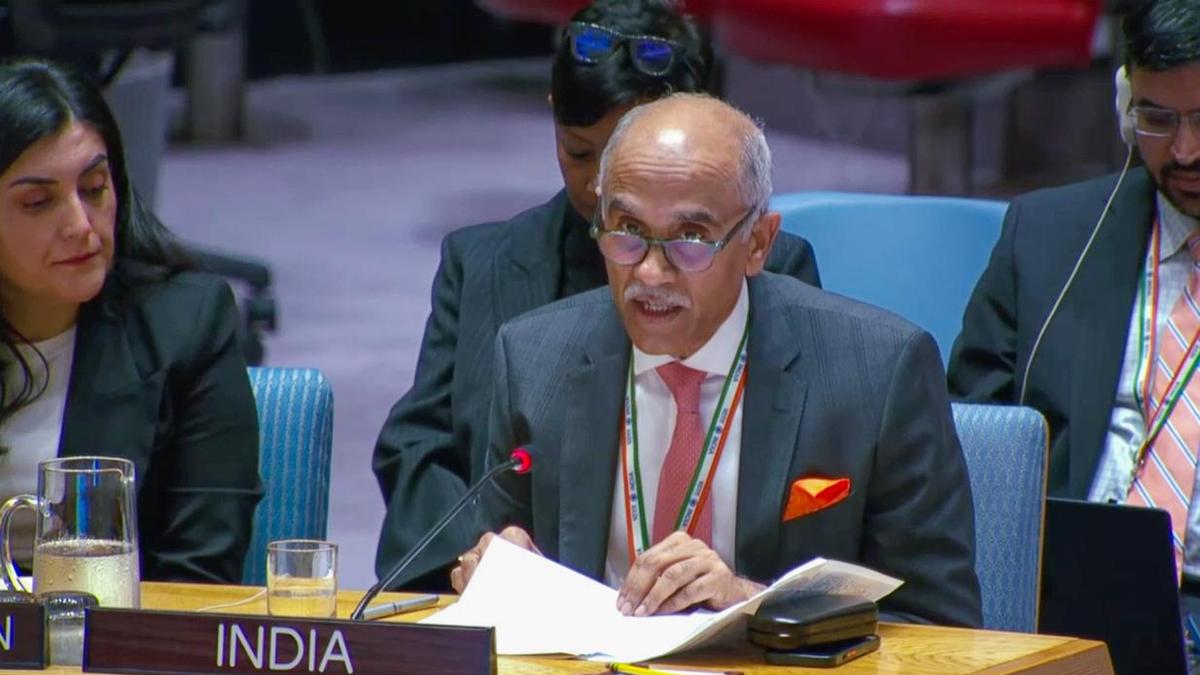
India's UN envoy Parvathaneni Harish made the remarks at a Security Council Arria-formula meeting on peace and security (ANI)
United Nations, 24 June
India slammed Pakistan for making “unwarranted” remarks on Jammu and Kashmir at an informal UN Security Council meeting organised by Beijing and Islamabad, asserting that the union territory is a matter "strictly internal" to the country.
India's
Permanent Representative to the UN, Ambassador Parvathaneni Harish, made the
remarks on Tuesday at an Arria-formula meeting of the Security Council on
'Bridging the Implementation Gap: Security Council Resolutions and the
Maintenance of International Peace and Security'.
"I
also refer to the unwarranted remarks made by the representative of Pakistan.
It is incredible that a co-chair expected to be balanced and unbiased in
conduct has chosen to politicise this forum,” Harish said.
“I would
only like to stress, for brevity of time, that the Union Territory of Jammu and
Kashmir is a matter strictly internal to India. It has always been, is, and
will remain so,” he said.
Harish's
remarks came after Pakistan's Permanent Representative to the UN, Ambassador
Asim Iftikhar Ahmad, raised the Jammu and Kashmir issue during his intervention
at the meeting, which was organised by the Permanent Missions of Pakistan and
China to the United Nations.
Pakistan is currently serving an elected two-year term as a non-permanent member of the
UN Security Council (UNSC) for 2025 and 2026.
India has
consistently maintained that the entire Union Territories of Jammu and Kashmir
and Ladakh are and will always remain an integral and inalienable part of the
country.
Relations
between India and Pakistan have remained strained over the Kashmir issue, with
New Delhi firmly rejecting any third-party mediation and maintaining that Jammu
and Kashmir is an internal matter.
Arria-formula
meetings are informal and confidential gatherings that allow Security Council
members and invited participants to exchange views in a flexible setting. The
format is named after former Venezuelan ambassador Diego Arria, who initiated
the practice in 1992.
Elaborating
on the broader subject under discussion, Harish said the UN Security Council is
entrusted with the maintenance of international peace and security and that the
UN Charter provides distinct mechanisms for addressing conflicts under Chapters
VI and VII.
He noted
that these two Chapters are distinct in nature and their applicability varies.
Harish
said Chapter VII measures are "aimed at maintenance or restoration of
international peace and security" in situations involving threats to
peace, breaches of peace and acts of aggression, and their non-implementation
could lead to "serious consequences".
Chapter
VI, the envoy said, is "fundamentally different” and offers a wide-ranging
set of options to deal with situations whose continuance is likely to endanger
the maintenance of international peace and security.
The
proposed tools that could be considered include negotiation, enquiry,
mediation, conciliation, and arbitration after taking into account any
procedures that may have already been adopted bilaterally by the parties
concerned.
"These
interventions are drawn up in order to address the prevailing realities and do
not have perpetual validity. They warrant a review in accordance with changing
circumstances and contexts,” Harish said.
"Multi-decadal
issues on the UNSC agenda offer valuable lessons in this regard. A case in
point is the Palestine issue, wherein a defining feature is the constant churn
of mediation frameworks in tune with the changing circumstances of the
conflict.
"There
exists an undeniable case for reviewing outdated mediation frameworks. Any
assumption of the perpetual applicability of a Chapter VI mediation
intervention is erroneous to say the least," he said.
India also
underlined that, as member states undertake reviews of UN General Assembly
mandates under the UN80 initiative to improve efficiency, there is no reason
why Security Council mandates should remain outside the scope of such reviews.
India has
long been pressing for permanent membership in a reformed and expanded Security
Council, contending that the current structure of the 15-member body is
outdated and does not adequately reflect contemporary global realities.
New
Delhi's candidature has received backing from a growing number of countries,
including several European nations, as well as the other members of the G4
grouping — Brazil, Germany and Japan.
UNSC comprises five permanent members -- China, France, Russia, the UK and the US -- and 10 non-permanent members, including India, elected for two-year terms.
Share Now

Leave a Reply
Your email address will not be published. Required fields are marked *
Other Stories





.png)