India pushes dialogue for West Asia peace, prioritises safety of its citizens: Jaishankar
India favours peace and urges dialogue and diplomacy, advocating de-escalation, restraint and safety of civilians, EAM said.
PTI
-
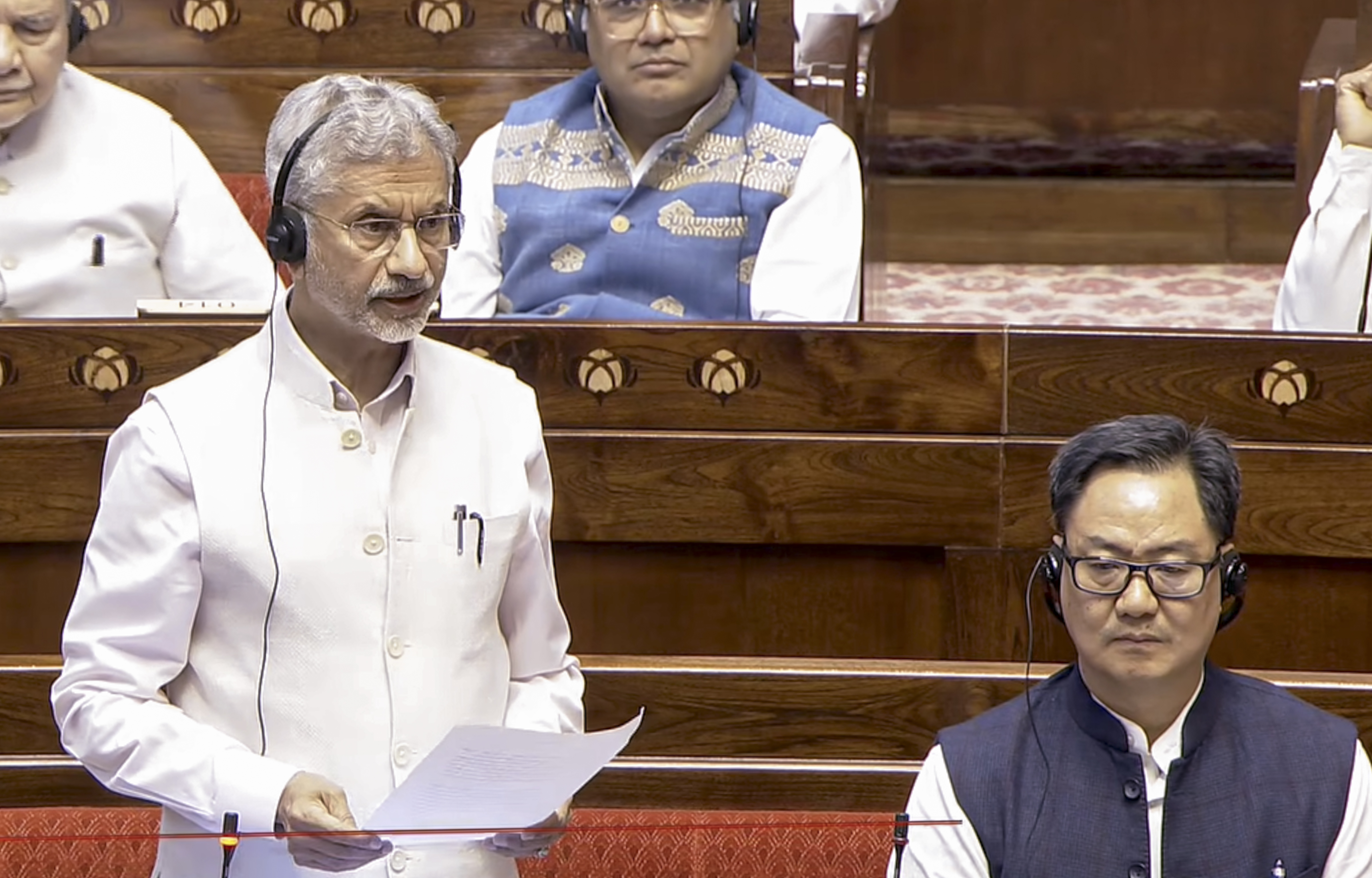
S Jaishanka said that safety of Indian nationals and national interests, including energy security and trade, remain the govt’s top priority (PTI)
New Delhi, 9 March
India on Monday advocated de-escalation of tensions in West Asia and called for dialogue and diplomacy to resolve all underlying issues, as it put the safety of around one crore Indians in the region as its top priority, along with securing energy security and trade.
The US
and Israel launched a major military attack on Iran on 28 February, and killed its 86-year-old Supreme Leader Ayatollah Ali Khamenei. The war has so far
killed at least 1,230 people in Iran, 397 in Lebanon, and 11 in Israel,
according to officials.
Making a
suo-motu statement in Parliament, External Affairs Minister S Jaishankar said
New Delhi stood for maintaining the sovereignty and territorial integrity of
all states in the region. He defended allowing the Iranian ship to dock at an
Indian port as the right decision taken on humanitarian grounds.
He said
the Indian government has been constantly monitoring the evolving situation in
the region at the highest level and has already brought back 67,000 stranded
Indians from the conflict zone.
Jaishankar
said the safety of Indian nationals and national interests, such as energy
security and trade, remain the topmost priority for the government.
India
is in favour of peace and urges a return to dialogue and diplomacy. We advocate
de-escalation, restraint, and ensuring the safety of civilians," he said
in identical statements in the Lok Sabha and Rajya Sabha.
"The
well-being and security of the Indian community in the region is our priority.
And our national interests, including energy security and trade, will always be
paramount," he said.
In both
houses, the Opposition staged vociferous protests as Jaishankar rose to make
his suo-motu statement, demanding that a full-fledged discussion should precede
his statement on the situation in West Asia. While the Opposition staged a
walkout in the Rajya Sabha, they forced the Lok Sabha to be adjourned amid
noisy scenes.
The
minister said the government had issued a statement on 28 February, expressing
its deep concern and urging all sides to exercise restraint, avoid escalation, and prioritise the safety of civilians.
"We
believed and continue to believe that dialogue and diplomacy should be pursued
to de-escalate tensions and address underlying issues. Sir, it is also
imperative that the sovereignty and territorial integrity of all states in the
region be respected," he stressed.
Jaishankar
said developments in the region are a cause of deep concern to "all of
us", and added that the conflict has continued to intensify and the
security situation in the region has deteriorated significantly.
The minister
emphasised that Prime Minister Narendra Modi continues to closely monitor
emerging developments and the relevant ministries are coordinating to ensure
effective responses.
He said
the prime minister has spoken to leaders of several countries in West Asia and
has received assurances that the well-being of the Indian community would be a
priority for them.
"I
have similarly been in close touch with my counterparts in these countries.
Insofar as the United States is concerned, we have maintained regular contacts
through diplomatic channels. While attempts have been made, contacts with Iran
at the leadership level are obviously difficult at this time. I have, however,
spoken to Foreign Minister Abbas Araghchi on 28 February and 5 March 2026. We
will continue these high-level conversations in the coming days," he
assured the house.
Jaishankar
informed Parliament about the steps taken by the government to bring back
Indians and provided details of the operation of flights by several airlines to
bring back those affected.
Referring
to concerns on the energy front amid rising global crude oil prices, he said
the government remains committed to ensuring that fully, taking into account
costs and risks of the energy markets.
"For
us, the interests of the Indian consumer have and will always be the overriding
priority. Where required, Indian diplomacy has supported the endeavours of our
energy enterprises in this volatile situation," he asserted.
On the
Iranian vessel currently docked in Kochi, the minister said the Iranian side
requested permission on 28 February for three ships in the region to dock at
Indian ports and permission was accorded on 1 March.
"IRIS
LAVAN actually docked on 04 March in Kochi. The crew is currently in Indian
naval facilities. We believe that this was the right thing to do, and the
Iranian Foreign Minister has expressed his country’s thanks for this humane
gesture," he said.
He noted
that in view of the large number of Indians living and working in Gulf
countries and a few thousand in Iran for study or employment, ensuring regional
stability was critical for India. The Gulf is also central to India's energy
security and trade, accounting for nearly USD 200 billion in commerce," he
said.
The
minister said attacks on merchant shipping have affected Indian seafarers, with
casualties reported and one Indian mariner still missing.
He also
informed Parliament that his ministry, as well as Indian embassies in West
Asian countries, had been issuing regular advisories to Indian citizens there,
asking them to avoid non-essential travel to Iran and advising those already
there to remain in contact with the Indian embassy.
The
Ministry of External Affairs has also set up a dedicated control room to
monitor the situation and respond to requests from Indian nationals, while the
Directorate General of Shipping has created a quick response team.
Share Now

Leave a Reply
Your email address will not be published. Required fields are marked *
Other Stories

.png)
.png)
.png)